History
A short history of Ystad and Österlen
The road that runs east out of Ystad has been walked for a very long time. It crosses fields turned for grain in the Bronze Age and ends at a beach where a ship made of standing stones faces the sea. Between those stones and the cobbled square at the foot of Fjädergränd lie roughly three thousand years of continuous habitation: Bronze Age chieftains, Iron Age sailors, Danish kings, Hanseatic herring traders, Franciscan friars, Lutheran reformers, garrison officers, spa‑takers, novelists, filmmakers. The town has the slightly improbable look of a place that ought to have been demolished in the nineteenth century and was not. About three hundred half‑timbered houses survive here, more than anywhere else in Sweden, because the railway, when it finally arrived in 1866, had already gone somewhere else first. Stagnation preserved what prosperity would have torn down.
The deep past
Before the town
The earliest grand monument in the region stands at Kivik, an hour north‑east of Ystad on the Baltic coast. The cairn called Kungagraven, the King's Grave, is around seventy‑five metres across and dates from roughly the fifteenth century BC. Two farmers stumbled into the central cist in 1748 looking for building stone and broke open a chamber lined with carved slabs showing ships, figures with raised arms, lurs being played, a chariot drawn by two horses with four‑spoked wheels. Nothing else like them is known from a Nordic Bronze Age burial. The archaeologist Gustaf Hallström excavated the site between 1931 and 1933.
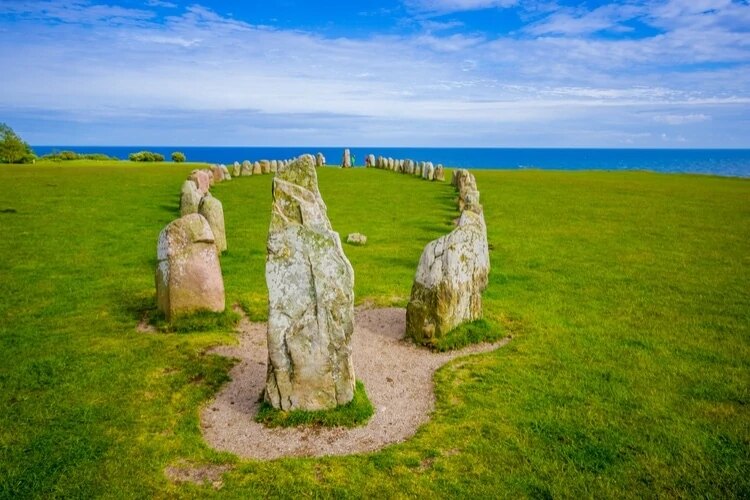
Roughly two thousand years later, a stone ship was raised at Kåseberga, ten kilometres south‑east of Ystad. Ales stenar, fifty‑nine boulders set in a long oval sixty‑seven metres in length, has been carbon‑dated by samples from inside the monument to around the sixth or seventh century AD. Whether it was a grave, a cult site, a calendar marking the moon's standstills, or all three, is still argued. For most of this period the area was not Swedish. It was a borderland of the Danish realm, and would remain so for another seven hundred years.
1244–1658
Medieval port
Ystad enters the written record in 1244, in a chronicle noting that the Danish king Erik IV visited the town with his brother Abel. By 1267 a knight called Holmger and his wife Katarina had endowed a Franciscan friary on the edge of town. The friary's brick church, dedicated to Saint Peter, still stands; the surviving east wing, Klostret i Ystad, is reckoned alongside Vadstena as one of the two best‑preserved medieval monasteries in Sweden. The parish church, Sankta Maria, was begun around the year 1200.
By the fourteenth century Ystad had joined the Hanseatic League and traded across the Baltic, importing salt and finished goods from Lübeck, grain and amber from Danzig, and exporting herring and, increasingly, cattle. A royal charter of 1599 confirmed the right to export oxen.
The Skåne herring fisheries were among the great food industries of medieval Europe. At their height, around thirty Hanseatic stations along the southern coast salted fish for markets from Flanders to Novgorod. The grid of narrow streets that survives in the old town, Fjädergränd among them, dates from this period: long, narrow lots running back from the street, the medieval merchant's plan.
Why the town survives
When growth stopped
The reason Ystad still looks the way it does is, in part, a piece of nineteenth‑century railway politics. When the Swedish state laid the southern trunk line in the 1850s and 1860s, it ran the route through Lund and Malmö, not through Ystad. A branch line reached the town in 1866, but by then the heavy industrial growth that tore down medieval centres elsewhere in Europe had bypassed it. The population was around 5,000 in 1850, drifted past 10,000 only when a garrison was established in the 1890s, and remained modest for the rest of the century. The old town was not torn down because there was neither money nor reason to tear it down.
What survived is the largest collection of half‑timbered houses in Sweden, around three hundred buildings from the fifteenth through eighteenth centuries. The oldest known timber‑frame house dates from the 1480s. The most photographed block, Per Helsas Gård, is a courtyard complex assembled in the sixteenth and seventeenth centuries, still described as the only fully preserved half‑timbered courtyard block in the Nordic countries.
The horn
The watchman still blows
Every evening, between a quarter past nine and one in the morning, a man climbs the tower of Sankta Maria kyrka and blows a copper horn through small windows facing the four cardinal directions. The signal is short and musical: one note at quarter past, two at half past, three at quarter to, four on the hour, repeated north, east, south and west. The full circuit takes about a quarter of an hour. The instrument is a straight horn of beaten copper, a kopparlur, whose sound is more felt than heard if you are standing on the cobbles below.
The tradition can be reliably dated to 1748. Until well into the twentieth century the signal was practical: a fire in a town of timber houses was an immediate civic emergency, and the man in the tower had the best view of the rooflines. The role today is ceremonial, organised through Klostret i Ystad, and Ystad is the only town in Sweden that has kept it as a living practice. Helmer Borg held it for thirty years; his son Roland took it on as a teenager and is, with a small group of colleagues, among those who still climb the steps each night.
1658
Skåne becomes Swedish
For most of its history, Skåne was Danish. The Treaty of Roskilde, signed on 26 February 1658, transferred the province along with Blekinge, Halland, Bohuslän and several Norwegian territories from Denmark‑Norway to Sweden. Article nine promised the Scanians their old laws and customs; the promise did not hold. Scanian law was replaced by Swedish law in 1683, the Swedish church ordinance imposed in 1686.
The province was tested again in the Scanian War of 1675 to 1679, when Danish forces invaded with support from an irregular pro‑Danish guerrilla, the snapphanar, drawn from the peasantry. Swedish reprisals were brutal: an order of 19 April 1678 directed that every farm in Örkened parish be burned and every man capable of using a rifle executed. The war ended in something close to a draw, but the territorial change held. The cultural transfer was slower and is not yet complete. Scanian dialects, with their uvular r and audible diphthongs, still sound to a Stockholmer like Danish that has been tidied and to a Copenhagener like Swedish that has gone slightly wrong.
The cure
Saltsjöbad
In 1896 the Ystad pharmacist Salomon Smith and his friend John Tengberg proposed a seaside hotel east of the town, on the beach where the pine plantations of the Sandskog meet the Baltic. The original Saltsjöbad, designed by the architect Peter Boisen, was a three‑storey wooden building of twelve rooms with verandas, a dining hall, and an annexe containing a warm bath house, the varmbadhus, and the more austere kallbadhus, a pier‑end pavilion of changing huts where men and women bathed separately in the cold sea. The hotel opened in 1897, and the main block was extended and dedicated in 1899.
The first building burned around 1913. The present main house, rebuilt in stages from 1927 onward, retains the white façade and verandas of the original, and Ystad Saltsjöbad has been more or less continuously in business as a hotel and spa for well over a century. The kallbadhus tradition, the cold dip from a wooden pier in any season, is still observed.
Mankell
Henning Mankell's Ystad
For most of the twentieth century Ystad was a quiet south‑coast town with a ferry harbour and a regiment. That changed in 1991 with the publication of Mördare utan ansikte, Faceless Killers, the first of Henning Mankell's novels about a melancholic Ystad police inspector named Kurt Wallander. Nine more followed, the last, Den orolige mannen, in 2009. The series was adapted twice for Swedish television in the 1990s and 2000s, and between 2008 and 2016 for the BBC starring Kenneth Branagh, filmed in and around the town.
The shoots used the old anti‑aircraft regiment Lv 4, decommissioned in 1997, as their production base. The site was redeveloped as Ystad Studios from the mid‑2000s and is now one of the larger film facilities in Scandinavia. Its public face, Cineteket, moved into the studio complex in 2018 and holds the props and standing sets from the Wallander productions. Mankell died in 2015.
A literary invention
The making of Österlen
The eastern half of the coastal region, from Ystad up to Åhus, is now called Österlen, "the land to the east." The name came into literary circulation only in the 1920s, through the writers Fritiof Nilsson Piraten and Pehr Theodor Tufvesson, and was formally defined in 1929 as covering the hundreds of Albo, Ingelstad and Järrestad. It denotes both a geography and a sensibility: rolling fields, fishing villages of tarred houses, white windmills, apple orchards around Kivik, a low coastline of sand and red sandstone.
Astrid Lindgren's 1977 film of Bröderna Lejonhjärta, The Brothers Lionheart, was shot in part in Brösarps backar, the rolling glacial hills north of Ystad. The cherry‑blossom valley in the film was contrived by tying pink plastic flowers to apple trees, since cherry orchards do not grow that way.
1499
Glimmingehus
Half an hour east of Ystad, in flat country above Hammenhög, stands the most complete late‑medieval castle in Scandinavia. Glimmingehus was begun in 1499 for the Danish knight, councillor and admiral Jens Holgersen Ulfstand, to the design of Adam van Düren, the North German master mason who also worked on Lund Cathedral, and was finished around 1506. It is a tall rectangular block of pale Scanian limestone, lower walls 2.4 metres thick, upper walls 1.8, with parapets, murder holes, false doors, dead‑end corridors and a flooded basement.
The castle very nearly came down. In 1676, during the Scanian War, Charles XI ordered Glimmingehus demolished to keep it out of Danish hands. A first attempt with twenty farmers and a second with a hundred and thirty men failed to make any real impression on the walls; the arrival of a Danish‑Dutch fleet at Ystad ended the effort. The Swedish National Heritage Board has administered the building since 1924. Selma Lagerlöf set one of the strongest passages of her 1906 children's book Nils Holgerssons underbara resa genom Sverige here.
A house on a cliff
Backåkra and Dag Hammarskjöld
On a low cliff above the Baltic, between Löderup and Sandhammaren, sits a long, white‑painted farmhouse called Backåkra. In 1957 Dag Hammarskjöld, then four years into his term as the second Secretary‑General of the United Nations, bought the farm and thirty hectares of pasture and heath around it. He had grown up in Uppsala Castle, the son of a Swedish prime minister, and Backåkra was meant to be the place where he retired to write and walk and look at the sea.
He did not get there. On the night of 17 to 18 September 1961 the Douglas DC‑6 carrying him from Léopoldville to a cease‑fire negotiation in Katanga crashed in forest near Ndola, in what is now Zambia. Hammarskjöld and the fifteen others aboard were killed; he was awarded the Nobel Peace Prize posthumously the same year, the only person ever to receive it after death.
The house was opened as a memorial museum. On Midsummer's Eve 1969 a meditation place was inaugurated in the field above the farm: a low ring of large stones designed by the church architect Thorsten Leon‑Nilsson and modelled on the meditation room Hammarskjöld himself had helped shape at the UN headquarters in New York. A single block of granite at the centre is carved with one word, PAX. The site is consecrated ground; the foundation that runs the farm keeps a small café and bookshop in the courtyard.
Today
The town as it is
The town of Ystad has roughly 20,000 inhabitants; the wider municipality just over 30,000. The ferry harbour runs two long‑established routes: a fast passenger and car service to Rønne on Bornholm, eighty minutes across, operated since 2018 by Bornholmslinjen with the catamaran HSC Express 1, and a longer overnight service to Świnoujście in Poland, around seven hours, run by Polferries on a route that has connected the two ports since the 1970s. The film studios at the old garrison employ several hundred people. In Österlen the permanent population is around forty thousand, and it roughly doubles in July and August.
The old town behind the harbour looks much as it did when Mankell first wrote about it, which is to say much as it did when Per Helsa kept his courtyard in the seventeenth century, which is to say much as it did when the Hanseatic herring boats put in. The square is still the square. The horn is still blown from the tower at quarter past nine. It is a town that has been allowed, by a series of accidents and decisions, to remain itself.
Further reading
Books and films
- Henning Mankell, Mördare utan ansikte (Ordfront, 1991) and the nine subsequent Wallander novels, 1992 to 2009.
- Selma Lagerlöf, Nils Holgerssons underbara resa genom Sverige (1906–1907), with its long Glimmingehus chapter.
- Fritiof Nilsson Piraten, Bombi Bitt och jag (1932), the classic Österlen comic novel.
- Sten Skansjö, Skånes historia (Historiska Media, second edition 2006).
- The BBC adaptation of Wallander, 2008–2016, with Kenneth Branagh.
- The 1977 film of Astrid Lindgren's Bröderna Lejonhjärta, dir. Olle Hellbom, partly shot in Brösarps backar.
Cared for by Dennis, Linn and the boys